Artificial intelligence: an introduction for beginners
In just a few years, artificial intelligence has gone from a topic for research conferences to a tool people use every …


Your phone unlocks when it sees your face. A camera in a factory spots a scratch on a part in a fraction of a second, one a person would miss. A car recognizes a pedestrian at a crossing. All of this is computer vision: the field that teaches machines to understand images. Let’s look at how a computer “sees,” what tasks it can solve and where it is used.
Computer vision is the set of methods for extracting useful information from photos or video. Not just storing a picture, but answering questions about it: what is in it? where exactly? how many? is there a defect?
For people, seeing is the easiest thing in the world. We recognize a friend in a crowd without thinking. For computers it was long one of the hardest problems. The reason becomes clear once you look at what a computer actually gets from a camera.
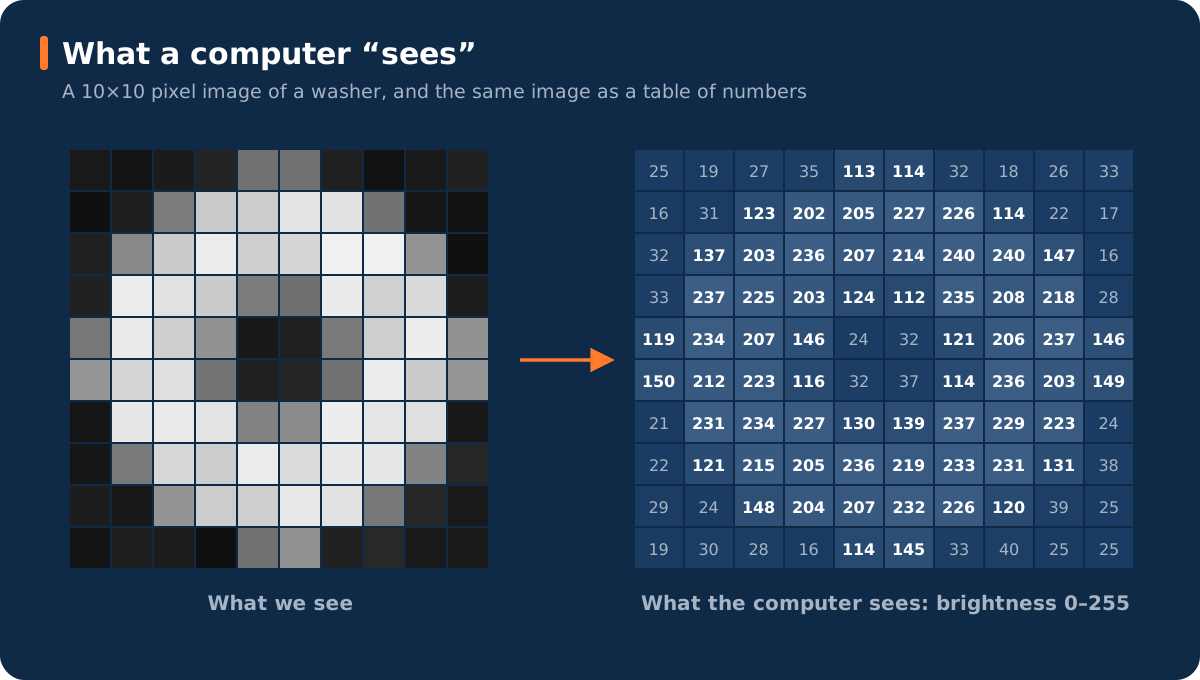
An image is made of pixels, small squares. In a black-and-white image each pixel is one number from 0 (black) to 255 (white). A color image has three such tables: red, green and blue (RGB). An ordinary 12-megapixel camera produces 36 million numbers per frame.
So a computer doesn’t see “a washer.” It sees a table of numbers. The job of computer vision is to find patterns in those numbers that correspond to a washer, a scratch or a face, and to do it so the result doesn’t change when the lighting, angle or background shifts a little.
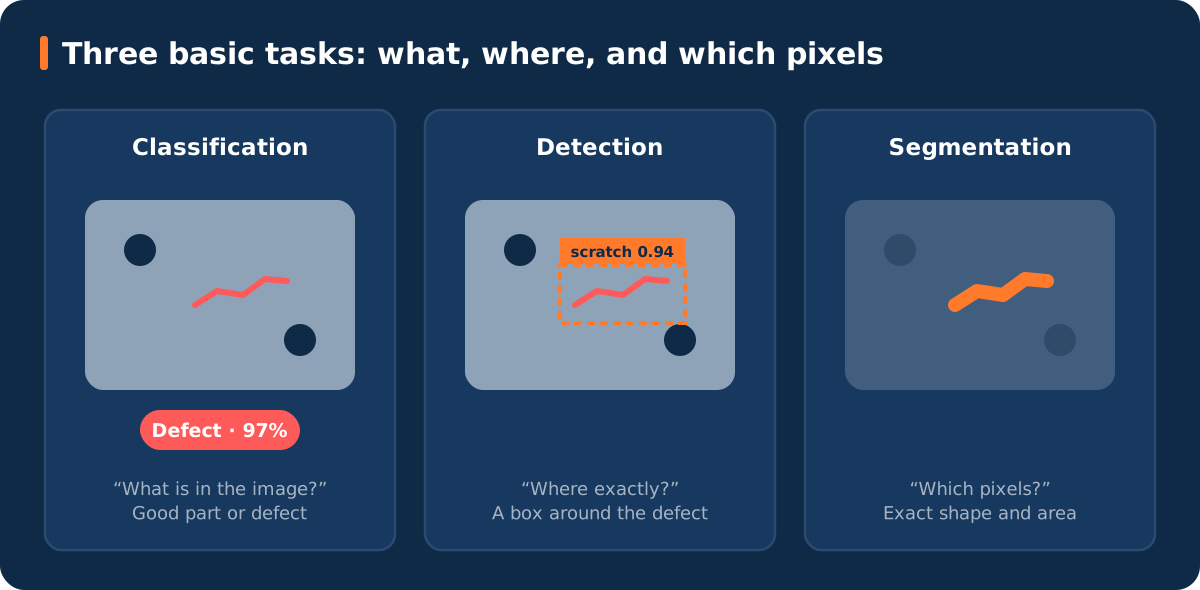
Beyond these there are reading text and codes (OCR), measuring dimensions, tracking objects across frames and estimating 3D position.
Classic computer vision is a toolbox of proven algorithms: filters, edge and contour detection, template matching. The engineer decides what to look for: “if there is a dark spot larger than 2 mm on a light background, it’s a defect.” These algorithms are fast, predictable and work well in controlled conditions. The best-known library for them is OpenCV.
Deep learning changed the field from around 2012. Instead of describing features by hand, you show a neural network thousands of examples, and it learns by itself what separates a scratch from a reflection. Popular models such as the YOLO family run real-time detection even on small devices. For more on how neural networks learn, see the introduction to artificial intelligence.
In practice the two are often combined: classic methods prepare the image and take precise measurements, while a neural network handles the hard decisions.
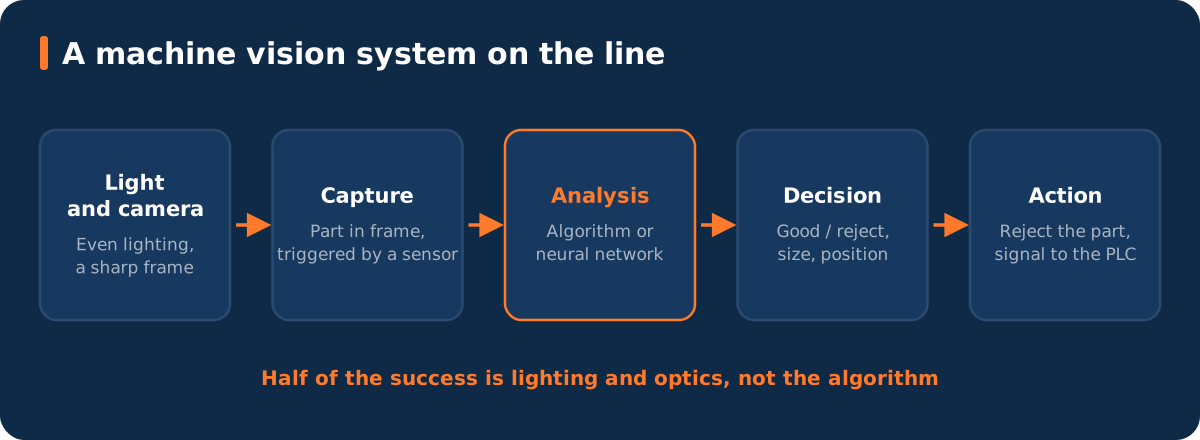
The main lesson everyone who builds these systems learns quickly: good lighting matters more than a clever algorithm. If a defect is barely visible in the image, no neural network will find it reliably.
A neural network has to be trained, and that takes labeled data: thousands of images where a person has marked what is a defect and what isn’t. Factories have a paradox here: there are millions of good parts but only a handful of defective ones. So people use augmentation (artificially rotating, relighting and adding noise to existing images), synthetic data (generating realistic defect images) and models that learn to spot “something unusual” from examples of normal parts only.
Computer vision is one of the most visible ways to see artificial intelligence at work in real production. In the next articles we will cover cameras, lighting and the first hands-on projects.
In just a few years, artificial intelligence has gone from a topic for research conferences to a tool people use every …
In recent years Ukrainians have learned more about energy than they ever wanted to: outage schedules, generators outside …