When people hear “robot,” most picture a metal human from the movies. In fact, the most common robot on the planet is an arm bolted to a factory floor, repeating the same motion thousands of times a day to within a few hundredths of a millimeter. Let’s look at how it works, what kinds of robots there are and why there are more of them every year.
What an industrial robot is
What sets a robot apart from an ordinary automatic machine is that it can be reprogrammed for a different task without rebuilding the hardware. A packaging machine can do one thing: pack. A robot welds car bodies today, and after a new program and gripper it stacks boxes.
The International Federation of Robotics (IFR) counts about 542,000 industrial robots installed worldwide in 2024 alone, twice as many as ten years earlier. In total, around 4.66 million robots are now working in factories, and more than two million of them are in China.
Why it matters
Robots get the jobs known as the “three Ds”: dirty, dull, dangerous.
Dangerous: welding, painting, handling hot or heavy parts.
Dull: moving 10,000 identical parts in a shift.
Precise: assembling electronics, where half a millimeter off means a reject.
There is one more reason: demographics. In many countries the working-age population is shrinking, and plants simply cannot hire anyone for the line. Robots don’t necessarily “take jobs”: often they fill positions nobody applies for, while people move to setup, maintenance and supervision.
What a robot is made of
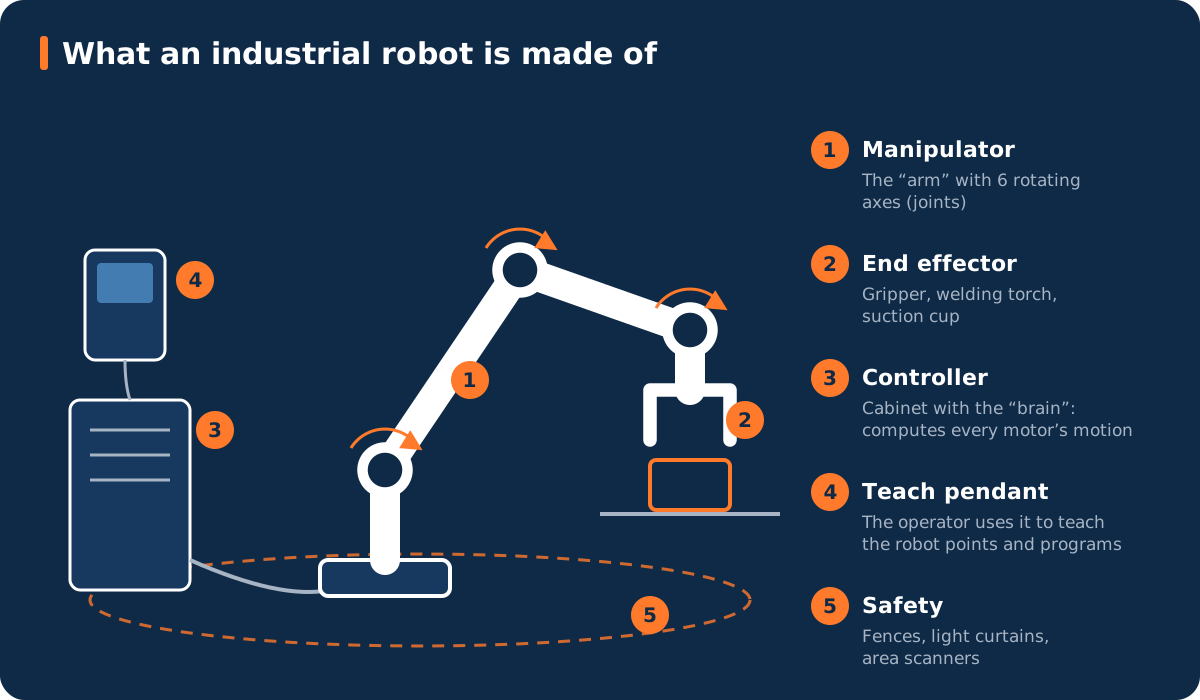
The main parts of a robot cell
Manipulator, the “arm” itself. A classic industrial robot has 6 axes: each axis is a joint with an electric motor. Six axes are enough to put a tool at any point in the work area at any angle, much like your arm from shoulder to wrist.
End effector, whatever the robot holds at the end: a gripper, a vacuum cup, a welding torch, a paint gun. The end effector decides what the robot actually does.
Controller, a cabinet of electronics that computes in real time how every motor must turn so the tool moves along a straight line.
Teach pendant, a tablet on a cable. The operator uses it to “drive” the robot, save points and build a program.
Safety: fences, light curtains, laser area scanners. If a person enters the zone, the robot slows down or stops.
The three specs people look at first when choosing a robot:
Payload: how many kilograms it can hold, tool included.
Reach: how far the arm extends.
Repeatability: how precisely the robot returns to the same point. For typical robots it is a few hundredths of a millimeter.
How a robot knows where to move
For the controller, each point is an X, Y, Z coordinate plus three tool angles. Its job is to turn “I want the tool here” into “rotate axis 1 by 32°, axis 2 by −15°…” This is called inverse kinematics. The good news: the controller does the math, and the programmer works with points and paths.
There are two ways to program a robot:
Online, with the pendant: move the robot to a point, save it, go to the next one. Simple, but the line stands still meanwhile.
Offline, in a simulator: build a 3D model of the cell on a computer (for example in ABB RobotStudio or similar tools from other vendors), write and test the program, then load the finished program onto the real robot.
Types of robots
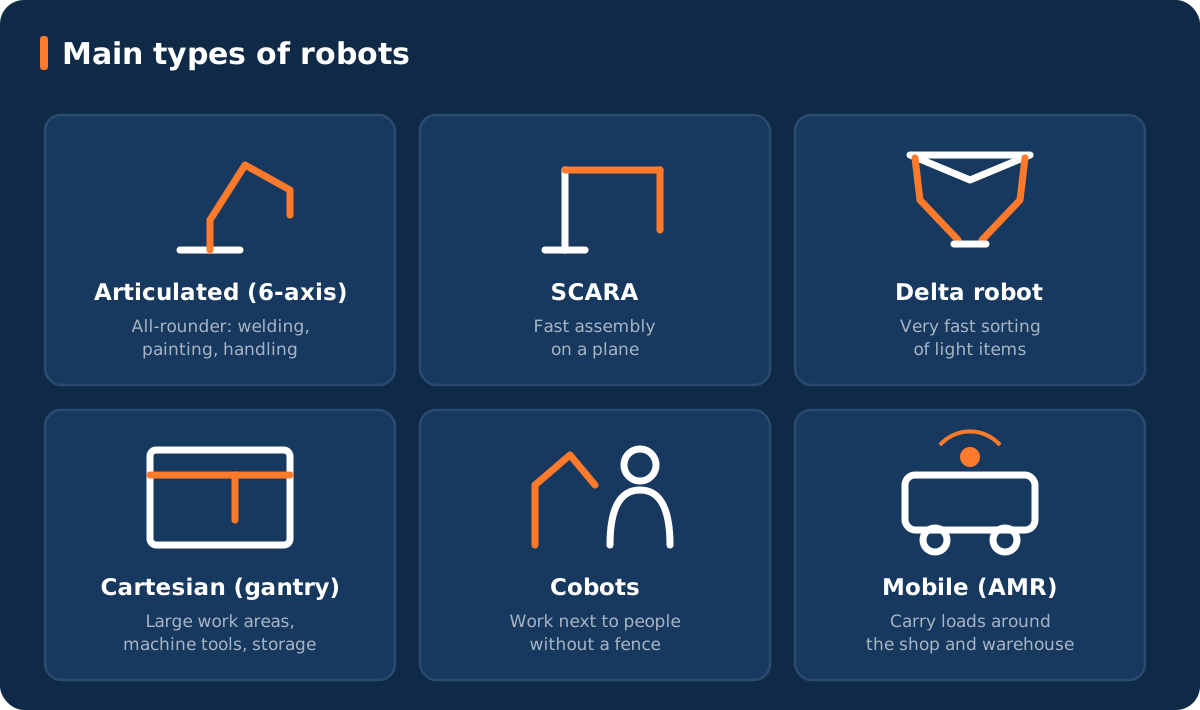
Each type has its niche
Articulated (6-axis): the all-rounders and the most common type.
SCARA: they move mostly in a horizontal plane and are very fast at assembling small parts.
Delta robots: they look like a spider hanging from above. They sort cookies, pills and small goods at incredible speed.
Cartesian (gantry): they move along straight X-Y-Z rails. Simple, precise, and capable of a huge work area.
Cobots (collaborative robots): lighter and slower, with force sensors. They can work next to people without a fence, if the risk assessment allows it.
Mobile robots (AMR): they drive around the shop and warehouse on their own, map the space and steer around people.
Safety is not optional
An industrial robot is strong and fast, and it doesn’t “see” a person unless sensors teach it to. That’s why robots have their own standards: ISO 10218 (a revised edition came out in 2025) and ISO/TS 15066 for humans and cobots working together. Even a cobot is not automatically safe: what is safe or not is the whole cell, including the tool, the part and the task.
Where the field is heading
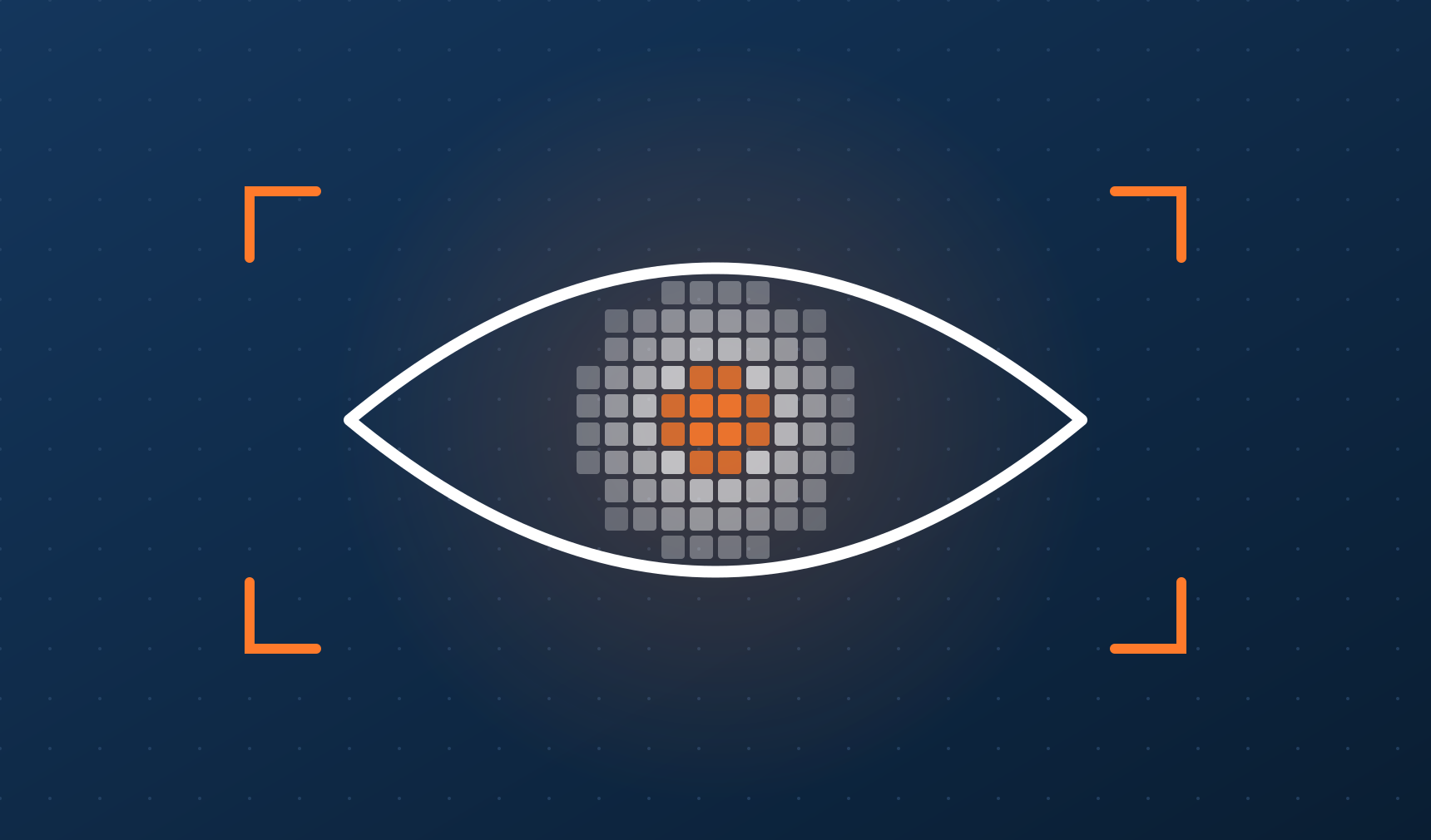
Robots that see. Cameras and computer vision let robots pick parts that lie randomly in a bin, not just ones in a fixed position.
AI for control. Models trained on human demonstrations learn to grasp new objects without programming every point by hand.
Mobile manipulators. An arm on a mobile base can drive up to a machine by itself.
Humanoids. Several companies are testing humanoid robots in factories and warehouses. For now these are pilots, not mass deployment, but progress is fast.
How to get started
Download a free or trial simulator from a robot maker and try programming a simple pick-and-place.
Brush up on school geometry: coordinate systems and angles are the language robots speak.
If you want hardware, build a small servo-driven robot arm. It is far from industrial, but the principles are the same.
A robot is always part of a wider industrial automation system: the same PLC controls it, and it gets parts from the same conveyor. In the next articles we will look at how this fits together in practice.